
For a PulsaCoil that has stopped supplying hot water or is leaking in Norbury, begin with a model-specific diagnosis before deciding on repair or replacement.
The right assessment can establish whether the fault is limited to a component or involves the thermal store itself. Norbury homes may have different PulsaCoil models, so the model label and reported problem help the repair engineer decide what to inspect.
Arranging a diagnosis is not the same as confirming that a repair is possible. The inspection should guide the recommendation, including whether replacement needs consideration. You can contact the booking team today to ask about appointment availability, including a next working day visit if one is available. An appointment request does not guarantee a particular repair or outcome.
Have the model details and a clear description of the problem ready when you book. If a leak is still active, tell the booking team that it is ongoing when you request help.
How a PulsaCoil thermal store supplies hot water
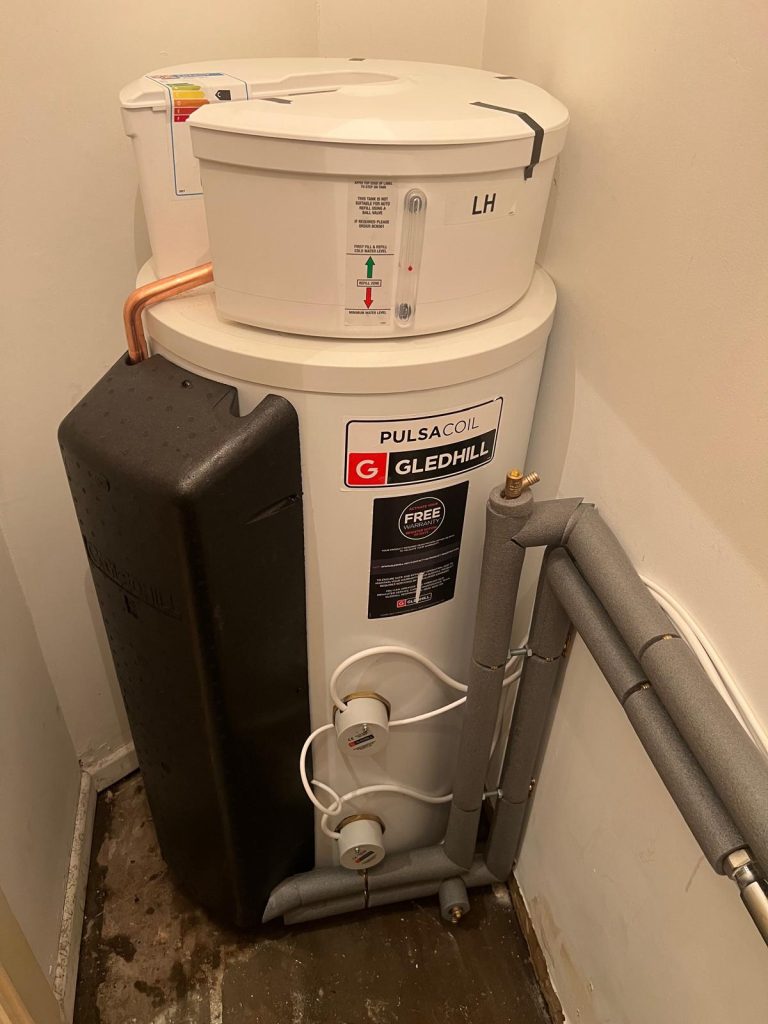
The Gledhill PulsaCoil Stainless stores heat and makes domestic hot water as mains cold water passes through its plate heat exchanger.
A plate heat exchanger is a component that transfers heat between two water circuits without mixing the water. In this model, stored heat warms the incoming mains water as it flows through the exchanger.
The Gledhill PulsaCoil Stainless is an open-vented thermal store, but it supplies hot water at mains pressure. The water held in the store provides heat, while the domestic hot water comes from the separate mains circuit. This separation explains how the system can deliver mains-pressure water without sending the store water to your taps.
These operating details apply specifically to the Gledhill PulsaCoil Stainless, not automatically to every pulsacoil model. The Stainless range is designed to use off-peak electricity, which heats the water held in the thermal store. Its stored heat is then used when you draw domestic hot water.
The Stainless generates domestic hot water through the plate heat exchanger, which eliminates any risk of Legionella in the generated hot water. The system also does not require discharge pipework from a temperature and pressure relief valve. Those design details are specific to this Gledhill model.
A change in hot-water output can have more than one possible cause. The temperature or flow you notice does not, by itself, confirm a failed thermal store. A repair engineer can inspect the relevant parts and establish whether the issue lies with a component, the heat transfer, or the store.
Knowing the model matters when you arrange a pulsacoil repair, since a different version may use a different layout or parts. Check the label if you can do so safely, without removing a cover. The model name gives the repair engineer a clearer starting point for diagnosis.
A change in hot-water output alone does not prove that the thermal store itself has failed.
Common PulsaCoil faults and what to report
A PulsaCoil fault can show up as no hot water, a leak or an electrical component problem, but the symptom does not identify the failed part by itself.
Give the repair engineer the details you can observe, rather than guessing which part needs replacing. When describing a fault, include when it began and whether it has changed. Clear notes can help the engineer prepare for the visit and consider which pulsacoil spare parts may be relevant.
| Symptom | What to note | What to report |
|---|---|---|
| No hot water | Time it stopped | Whether the whole supply is affected |
| Leak | Visible location | Whether water is still escaping |
| Immersion heater failure | Any change in hot-water availability | When the change began |
| Hot-water sensor failure | Any unusual reading | Unusual behaviour or readings |
A leak can be difficult to trace from a brief description, especially if water has run along a pipe or surface. Report the place where you can see water and whether it is continuing to escape. Do not remove covers to look for the source.
Other reported PulsaCoil issues include depleted water in the thermal store and a store that has rusted through. These are possible faults for an engineer to assess, not conclusions you can draw from a symptom alone. The condition of the unit needs inspection before repair or replacement is recommended.
An immersion heater or hot-water sensor may need repair, but a change in supply does not confirm which part has failed. Give the engineer any unusual readings or changes in behaviour you have noticed. Avoid trying to test electrical components yourself.
Electrical problems can also cause a circuit to trip. Note whether a trip affects only the PulsaCoil circuit or the whole home, without opening the unit.
Pulsacoil Repair Norbury: choosing a specialist engineer
The right repair route depends on the exact PulsaCoil model and whether the fault appears electrical, plumbing-related or both.
The range includes PulsaCoil, PulsaCoil 3, PulsaCoil 2000, PulsaCoil A Class, PulsaCoil BP, PulsaCoil PCR and ThermaCoil. A specialist who recognises your model may focus the diagnosis more effectively. That does not guarantee that the required part is available or that the repair can be completed on the first visit.
Before confirming a visit, use this checklist:
- Identify the model from its label.
- Describe the symptom and when it began.
- Ask whether the engineer works on that model and can source its relevant parts.
- Confirm who will handle electrical or plumbing work if the fault crosses both.
A local heating or electrical contractor may be suitable for some work, while a PulsaCoil specialist may have more direct experience with a particular version. Ask what work the proposed visit covers, especially if the fault may need both plumbing and electrical attention. A qualified pulsacoil approved engineer should be able to explain their experience with your model.
G3 qualification requirements should not be assumed to apply to every PulsaCoil model. Installing a Gledhill PulsaCoil Stainless does not require a G3 qualification. That detail applies to the Stainless model and is not general advice for other versions.
Ask who is responsible for coordinating work if more than one trade is needed. Agreeing that point before the visit can make the scope clearer and help you understand who will carry out each task. Before authorising work, ask whether the recommendation is a repair or a replacement and what that scope includes.
What happens during diagnosis and repair
A repair visit should start by confirming the model and symptoms, then diagnosing the cause before any work is agreed.
The repair engineer should inspect the parts linked to the reported problem and assess the condition of the unit. The inspection may involve the electrical components, water connections or other relevant parts. The checks should suit the model and the symptoms you have described.
After diagnosis, the engineer should explain the finding and set out the proposed work. You can then decide whether to agree to that work before repairs begin. If the finding changes the expected scope, ask for the revised recommendation and any cost implications before authorising more work.
Possible repair work includes component replacement, electrical repairs and leak repairs. Which option is suitable depends on what the inspection finds. Replacing a component may address a fault, but no repair type is a guaranteed remedy before the cause has been confirmed.
A thermal store that has rusted through may need replacement consideration, as a repair to another part might not resolve the condition of the store. The final choice depends on inspection and the unit’s overall condition. Ask the repair engineer to explain why the proposed option suits the fault found.
Repair and replacement are different scopes of work. A repair may focus on a failed component or connection, while replacement concerns the unit itself. A diagnosis should make clear which option is being recommended and what work that option includes.
The Gledhill PulsaCoil Stainless does not require annual maintenance or a safety check. This statement is specific to the Stainless model, and should not be treated as a schedule for every PulsaCoil version. Check the instructions for your own model if you need model-specific care information.
Do not arrange annual maintenance for a PulsaCoil Stainless solely because another system has a different service schedule.
Repair costs, parts and booking details
Ask for a clear repair scope before agreeing to a visit, especially if the fault may require parts or a second attendance.
A repair quote for a Norbury job should identify the PulsaCoil model and the fault being priced. The final quote depends on the model, diagnosed fault, parts required and access to the unit. A written scope helps you see what the quoted work covers.
Before booking, clarify these points:
- Provide the model and a clear description of the fault.
- Ask whether diagnosis has a separate charge.
- Request a written breakdown of labour and parts.
- Confirm how additional work or a return visit would be approved and priced.
Check whether the quote includes labour, parts, any diagnostic charge and any return visit. If an item is outside the stated scope, ask how it will be priced before you agree to that work. This helps distinguish the initial inspection from any later repair attendance.
Repair and replacement are options to compare by scope, not just by headline price. A repair quote may cover a specific component, while replacement includes a different set of work. The benefits fixed-price repair offers are easier to judge when you know exactly which labour and parts it includes.
Ask how the repair engineer will handle parts that cannot be confirmed until diagnosis. A written breakdown can also show whether a return visit is included or priced separately. Do not assume that a quoted repair includes work beyond its stated scope.
Keep the written scope and payment record with the unit paperwork.
Arrange a safe next step for your hot water
A clear model and fault description gives the repair team a more useful starting point for arranging help. A diagnosis should guide whether repair or replacement is the sensible choice, rather than age or one symptom alone.
Have the model label and your notes ready when you contact the team. You can describe what has stopped working and mention any active leak. The booking team can tell you which appointment times are currently available.
Use the site’s booking or contact route to request a Norbury visit and confirm the next available appointment.
FAQ
Can I reset a tripped PulsaCoil myself?
You can report a trip, but do not open the casing or work on wiring. Note whether the trip affects only the PulsaCoil circuit or the wider home, then share that detail when arranging help. A trip may need assessment before the unit is used again. If you are unsure which circuit has tripped, do not remove a cover to check.
How can I tell whether a leak is coming from the store or nearby pipework?
You may not be able to confirm the source safely from outside the unit. Describe where you can see water and whether it is still escaping, then let the repair engineer inspect it. Water can travel along a surface or pipe before becoming visible. Do not remove covers or move parts to investigate the store or nearby connections.
Can a PulsaCoil fault affect heating as well as hot water?
Yes, a PulsaCoil fault can affect more than hot water, depending on how the system is connected in your home. Connections vary between installations, so report which services have stopped working. Avoid assuming that heating and hot water share one cause. The repair engineer can assess the connections and determine whether the reported problems are linked.
Does an older PulsaCoil always need replacing?
No, age alone does not mean a PulsaCoil needs replacement. The condition of the thermal store, the fault found and the proposed repair scope all matter. An inspection can establish whether a repair is suitable or whether replacement needs consideration. Ask the repair engineer to explain the finding behind the recommendation before agreeing to either option.
How long does a PulsaCoil repair take?
The time depends on the diagnosis, access to the unit and whether the required part is available. A repair engineer can give a more useful estimate after assessing the fault and confirming the work needed. A return visit may be needed if a part is not on hand. Ask what the proposed timing includes before agreeing to the repair.
Can I request a next-working-day repair in Norbury?
Yes, you can ask about a next-working-day repair in Norbury, but the booking team must confirm current appointment availability. The PulsaCoil model and any parts needed may affect scheduling. Give the team the model and a short description of the fault when you contact them. An appointment request does not guarantee that a repair will be completed that day.